Getting to Know Your Board
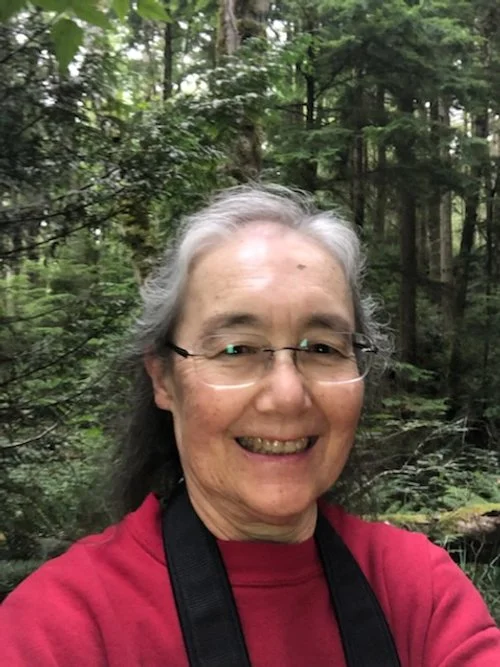
Linda Rhodes, At large board member.
Linda Rhodes, a longtime Greenbank resident who retired from a career as a research microbiologist at NOAA, joined the Audubon board earlier this year. We talked with Linda about her life on Whidbey and work with Audubon.
What brought you to Whidbey Island?
My partner, Vernon, and I moved from Bainbridge Island to Whidbey, into the house where we live now, in 1987. One thing that attracted us to the island was the abundance of natural settings. I’m not agriculturally inclined at all, but I like to see native plants and animals and learn how to live in—and not fear—natural settings.
For many years, Vernon and I lived off the electric grid, relying on solar panels and batteries. We chose to be energy-accountable because it forced us to modify our behavior and learn what is truly important for our existence.
When did you get involved with Whidbey Audubon Society?
I joined Whidbey Audubon in late 80s. I was still working then—commuting to the NOAA laboratory near the University of Washington—and I didn’t have time to do anything with the organization. I basically just paid dues. Now I have more time to get involved in activities, including serving on the board.
What interests you most about Audubon’s work?
Although I've been looking at birds for decades, I’m a newcomer to the level of bird identification exhibited in field trips, and I really respect the expertise of the members who generously share their knowledge about bird species.
I’m particularly interested in the natural history of birds—what they are doing, what they are eating, how they are interacting with their environment and with other animals. I spent most of my career with fish and aquatic animals, so birds are new territory for me. From my perspective, birds are great integrators, connecting adjacent ecosystems. I believe that the more people understand how linked these systems are, the more they will care about those systems.
Why did you join the board?
I felt like I could be useful from the scientific aspect. Being a board member gives me a seat at the table and a little bit more authority when important conservation issues are being discussed. The process of having Audubon named the Adopt-a-Park Steward for Deer Lagoon is a great example.
What other organizations have you been involved with on Whidbey?
From 2011 to 2020, I was a member of the Island County Marine Resources Committee. We started a citizen-based bull kelp monitoring program in 2015 that continues to contribute data used by state agencies and helped designate bull kelp as Washington State's official marine forest in 2025.
I’m currently serving on the Citizens Advisory Board that advises Island County on how to allocate Conservation Futures funds. And I represent Whidbey Audubon as a member of the Puget Sound Partnership's Marine Birds Work Group.
We always ask: Do you have a favorite bird?
Not really. I like them all. But maybe I just haven’t met my favorite bird yet.